How does it help our fearful, anxious and reactive dogs?
Freework is animal centred education (ACE) which was devised by Sarah Fisher, in order to observe an individual dog’s behaviour. It can be used for sensitive, fearful, anxious and reactive dogs, such as new rescue dogs and even high energy dogs. It goes beyond standard training techniques and gives the dog complete control of their actions in a gentle, calm, peaceful and enriching environment. It provides mental stimulation as well as being fun and engaging, the more they do, the more that they will want to do!
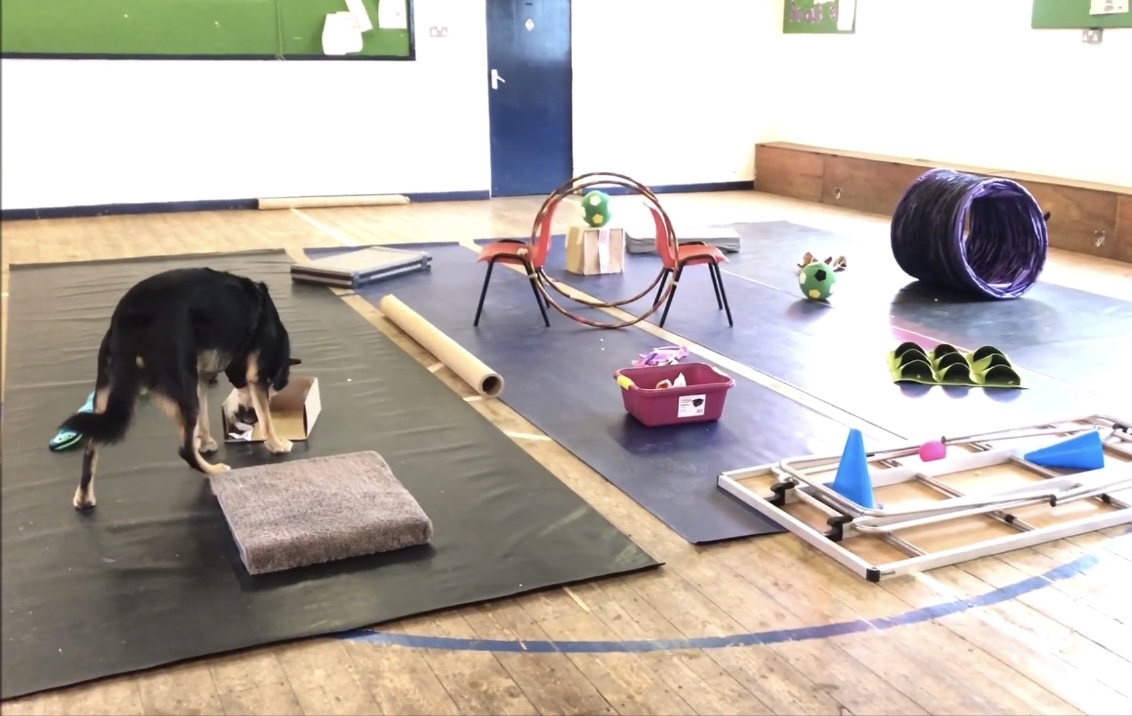
Freework, is basically where a number of obstacles and textures of different heights are set up around an area and food rewards are hidden amongst them and on them. This can include items such as rolled up towels, rugs, snuffle mats, licki-mats, milk cartons, yoghurt pots, plastic boxes with food smeared on, cardboard boxes, different textures to walk on such as bubble wrap, foil, coarse door mat and any safe items that you might have around the house. The dog is then allowed to explore the items at their leisure where they will search for the food hidden among them, choosing where they want to go without any human interaction (unless they need some gentle persuasion).
Freework enables us to observe their posture, movement and nervous responses. This gives us a good indication of how the dog will react to different scenarios. Are they fast or slow, confident or cautious of certain items, if so which ones?
Freework will give the dog choices and success at achieving a task and will empower them to know that they can try other tasks and succeed.
Freework is great for improving the dog’s confidence and resilience, self-belief,
industriousness and empowerment. Self-discovered solutions and self-reliant mastery of challenges activate positive feelings, allowing the dog to seek out new challenges. It helps to build calm foundations and builds trust in their own ability and allows the dog to build on this with
further learning.
The natural instinct of sniffing and searching in the dog will be internally rewarding causing the release of dopamine which acts on the reward centre in the brain. The success of finding the food, releasing feel good chemicals and the release of dopamine will then increase the motivation in the dog to repeat the activity, building even more confidence.
Date: 14/10/2025